


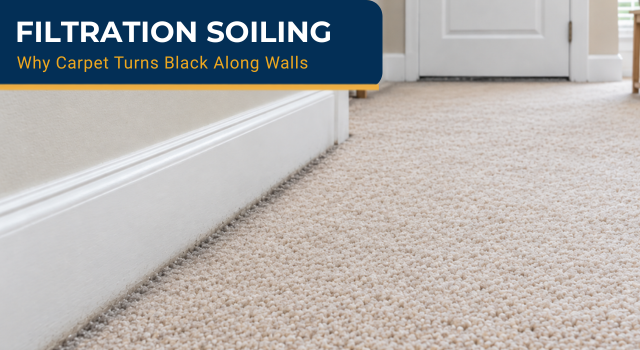
Black lines along carpet edges are usually caused by filtration soiling. This happens when air moves through small gaps under baseboards, doors, or stairs and passes through the carpet. The carpet acts like a filter, trapping fine dust, soot, oils, and other airborne particles. It is primarily an airflow and indoor-air issue, not a sign of poor housekeeping.
You vacuum every week, yet there it is. A gray shadow hugging the baseboard, a dark strip under the bedroom door, a dingy line running up the side of the stairs. It looks like ordinary dirt, but no amount of vacuuming seems to touch those dark carpet edges.
At Heaven’s Best Carpet Cleaning, homeowners ask us about these black carpet stains all the time, from condos in Coral Springs to family homes in Parkland and Boca Raton. The good news is that they have a clear cause, they are rarely a sign of anything serious, and in most homes professional carpet cleaning can improve them a lot. In this guide, we explain what causes these lines, how to tell them apart from mold, and exactly how our team removes them.
What is Filtration Soiling on carpet?
Filtration Soiling is the industry name for dark, grayish lines on carpet. According to the Carpet and Rug Institute, it is not a defect in the carpet. It happens when dust, smog, and other airborne pollutants collect on the fibers in spots where air flows in a concentrated path over the carpet or through small openings beneath it. In simple terms, the edge of your carpet is working like an air filter. Air moves through it, and the carpet fibers hold on to whatever the air was carrying.
These lines can show up fast or build slowly over months or years. How dark they get depends on how much air moves through the area and how polluted that air is.
Did You Know? Carpet quality has nothing to do with it. An expensive carpet and a budget carpet will both show dirty carpet edges if the airflow and pollutants are there.
What causes Black Lines on Carpet along walls?
Most homes have small gaps where the drywall meets the subfloor, under baseboards, and along the sides of staircases. Air naturally looks for those openings.
The Carpet and Rug Institute points to your ventilation system as a common cause. When more air enters a room than the HVAC system can pull back out, the extra air escapes through gaps along walls and stairs.
Here in South Florida, our air conditioning runs for much of the year. That means air is moving through those gaps almost constantly, which can make black lines on carpet show up sooner. We see this most often in homes where the AC runs around the clock, including condos and seasonal homes that stay closed up for months. Closed doors play a part too. Soiling often builds up under interior doors that stay shut, which is why leaving those doors open can help reduce it.
What are Dark Lines on Carpet made of?
The dark color comes from tiny particles floating in your indoor air, including:
- Soot from candles and fireplaces
- Cooking oil vapors from the kitchen
- Vehicle exhaust, especially in homes with an attached garage
- Everyday dust, pollen, and outdoor pollution
Oily particles are the real troublemakers, because once the carpet traps them they help attract even more dirt. Your carpet traps plenty of other things too, which we cover in our look at the hidden dangers in your carpet.
Is it Filtration Soiling, mold, or something else
Look for dark lines or gray shading in these spots:
- Along baseboards, especially on exterior walls
- Under bedroom and bathroom doors that stay closed
- Along the edges of carpeted stairs
- Around air returns and floor vents
- Under long drapes that hang to the floor
If the darkest areas line up with walls, doors, and vents rather than walking paths, filtration soiling is the most likely cause
Filtration Soiling or mold? How to tell the difference
Not every dark carpet edge has the same cause. This quick comparison helps you tell them apart.
| Clue | Filtration Soiling | Moisture or mold | Traffic soil |
| Shape | Thin, straight lines along walls and doors | Irregular patches | Wide lanes in walking paths |
| Feel | Dry | Often damp | Dry, may feel matted |
| Smell | No odor | Musty | Usually none |
| Location | Baseboards, stairs, under doors, vents | Near leaks, windows, AC units | Hallways, doorways, in front of sofas |
Important: If a dark edge feels damp, smells musty, or has an uneven shape, treat it as a possible moisture issue. Check for a roof, plumbing, window, or AC leak before cleaning, since carpet cleaning alone will not fix a water problem.
Not sure what you are looking at? During a visit, we can check the area and tell you honestly whether cleaning will help or whether a leak needs attention first.
Can you remove Black Lines on Carpet Edges yourself?
Regular vacuuming along the edges with a crevice tool can slow new buildup. Once the lines have formed, though, DIY fixes usually disappoint.
The particles are extremely fine and often oily, so they bond tightly to the fibers. These soils often require specialized cleaning solutions and techniques to remove effectively, which is why the Carpet and Rug Institute recommends calling a professional carpet cleaner.
Hard scrubbing can fray the fibers and spread the soil into a wider gray band. Household spot cleaners can also leave sticky residue that attracts more dirt. We explain more of these pitfalls in our guide to DIY carpet cleaning mistakes. If a DIY attempt has already left a gray smear, do not worry. In many cases, the right pretreatment can still bring the edges back.
How Professional Carpet Cleaning Removes Filtration Lines
At Heaven’s Best, we treat filtration lines as their own job instead of giving the edges a quick pass:
- Confirm the cause: We check that the lines are dry airflow soil and not moisture.
- Detail vacuum the edges: A crevice tool pulls out loose particles along the baseboard.
- Pretreat the lines: We apply a spotter made for fine, oily soils and give it time to work.
- Agitate by hand: Careful work along the wall loosens soil without fraying fibers.
- Clean the whole room: Our low moisture process blends the edges with the rest of the carpet.
- Offer protection: Newer soil and stain resist treatments have made filtration soil easier to remove. Our fabric protectors guide explains how they work.
Because our low moisture method uses very little water, we can work right up to the baseboards without soaking the padding. That reduces the risk of stains wicking back up or musty odors forming afterward.
Important: We will always be honest with you about results. No single cleaning method works in every filtration soiling case. Most lines lighten dramatically, but heavy lines that have built up for many years may not disappear completely.
How to prevent Filtration Soiling in your home
Cleaning removes the lines, but slowing the airflow and cutting down pollutants keeps your carpet edges cleaner for longer.
- Seal the gaps: Sealing cracks in the subfloor, under baseboards, and along stair edges may reduce the problem by blocking the airflow through the carpet.
- Change your AC filter on schedule: A clean, properly fitted filter catches more particles before they reach the carpet.
- Keep doors open: Leave interior doors open when you can, especially overnight.
- Limit candle soot: Trim wicks short and burn candles less often in carpeted rooms.
- Run the exhaust fan: Use your kitchen exhaust fan every time you cook with oil.
- Vacuum the edges: Use a crevice tool weekly, not just on the open floor.
- Check your HVAC: Have your system checked if the lines return fast, since leaky or unbalanced ducts push extra air through the walls.
Better filtration helps more than your carpet. Cleaner indoor air benefits the whole household, which we cover in our post on carpet cleaning and indoor air quality. When we clean your carpet, we are happy to point out the spots where airflow is causing the most soiling, so you know where to focus.
Say goodbye to dark carpet edges with Professional Carpet Cleaning
With more than 40 years of experience behind our name, Heaven’s Best Carpet Cleaning helps homeowners get rid of stubborn black lines, dirty carpet edges, and everyday stains across South Florida. We proudly serve Coconut Creek, Coral Springs, Parkland, Margate, Tamarac, Deerfield Beach, Pompano Beach, and Boca Raton.
Our family team uses environmentally friendly, pet and child safe solutions, and our low moisture carpet cleaning leaves most carpets dry in about an hour. You get firm appointment times and upfront pricing with no surprises. Along with carpet cleaning, we also offer professional upholstery cleaning, area rug cleaning, and commercial carpet cleaning.
Ready for carpet that looks clean all the way to the walls? Trust Heaven’s Best Carpet Cleaning. Call 954.821.8198 today or schedule your appointment online.